Broken pieces, joined with gold.
More beautiful, and stronger than before.
Kintsugi (金継ぎ) is the Japanese craft of repairing broken pottery by joining the pieces with gold lacquer. The fracture is not hidden. The seam is the most beautiful part of the finished object. Less obviously, it is also where the bowl is the strongest. That is the company at every scale.
Tsugi (継ぎ).
The seam itself.
The cinema home is fractured. The hardware in your living room can resolve a 12-bit gradient. The signal you receive is 8-bit. The TV manufacturers pushed past 4K and then past HDR. Streaming did not follow.
We do not pretend the fracture is not there. We rejoin the pieces. The seam is what makes the whole thing worth looking at and stronger than what it replaces. That is the brand. That is the architecture. That is why every page on this site has a thin gold rule somewhere.
“home theater rewoven” is the picture you were always supposed to see, on the hardware you already own, with the gold seam visible if you look for it.
Small parts joined by gold,
do more than one big thing alone.
The thesis is fractal. The Kintsugi seam is not a metaphor for the brand alone. It is the architecture, repeated at every scale of the company. A repaired bowl is stronger than the original because the gold transfers load across the seam, not through the weaker ceramic. The same logic carries from silicon to networks.
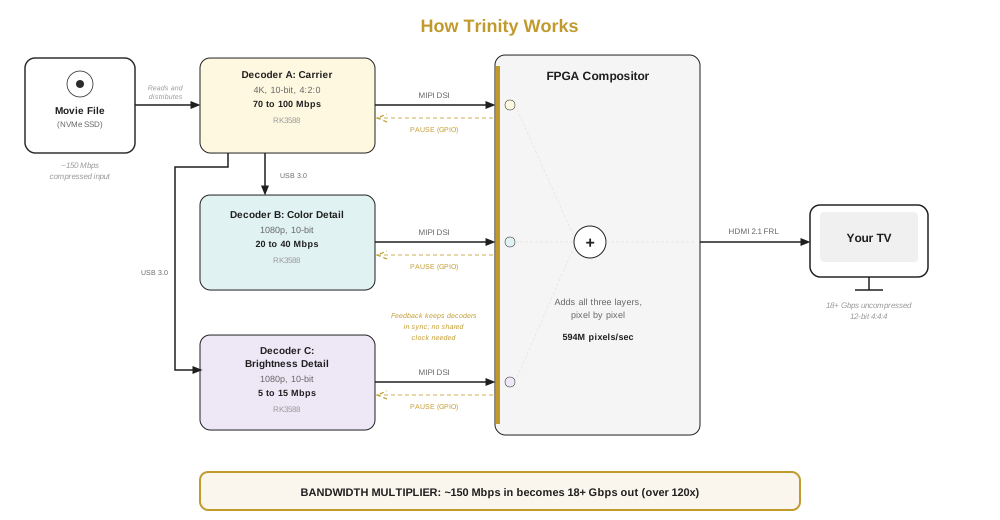
Three small decoders, in unison.
Trinity is a multi-decoder synchronization fabric that joins three commodity 8-bit video decoders at sub-nanosecond timing precision. Three smaller chips, working as one, deliver 12-bit master-quality color that no single consumer SoC can reach alone. More capable, on cheaper silicon.
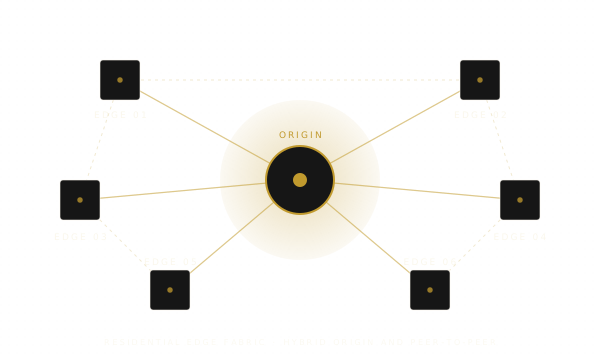
Many smaller nodes, in unison.
Each TsugiNode is designed to serve as a delivery peer (Phase 1), a storage cache (Phase 2), and one day (Phases 3 and 4) a compute node. The Infinity gradient-consensus apparatus is what would let thousands of household devices train and serve models together at the same sub-nanosecond timing precision. Enough nodes joined this way could one day carry workloads that today require a data center.
The pattern repeats at every scale. The gold is the seam. The seam is the company.
TsugiCinema Inc.
Delaware C-Corp. 2026. San Francisco.
April 2026
Delaware C-Corp. Equity-only team at pre-seed. Pre-seed round closed 2026-Q2; not currently raising.
Seven filed US provisionals
Cinema stack: Trinity (synchronization), Dual-Layer Compression (DLC), Infinity (gradient consensus). TsugiAI Optimization Division: K-Pool LoRA, MRRO, CMLGS, HAMO. Independently externally validated for novelty across the portfolio.
Live in homes
Active closed alpha program. Master-quality 4K running on the TsugiNode in real customer homes today.
A small team.
All equity-only at pre-seed.
Two cofounders and one fractional executive at the operational core. Chief Science Advisor and lead investor Shaheen Hoque, a 30-year guidance, navigation, and control engineer (Lockheed Martin, Raytheon, Orbital Sciences, currently Director of GNC at Atropos Group and Adjunct Professor at Cal Poly San Luis Obispo), is engaged part-time today with a full-time path under discussion. A senior technical bench of frontier-lab AI researchers and ML systems engineers is engaged under confidentiality, with names and roles disclosed to qualified strategic partners under NDA.
Come see it
on a real reference display.
San Francisco demo room is open by appointment. The alpha cohort is open by waitlist.