We put the power of compute, storage, and AI
back in the hands of the people.
The same TsugiNode that drives your TV to its full potential is designed to one day serve as a node in a residential delivery, storage, and compute grid. Nodes would join as a side effect of wanting the picture. No crypto-speculation cold start. The architecture is the long bet.
Residential edge wins
on the margin that matters.
The data center wins on raw density. It loses on power, cooling, latency to the user, and consumer agency. Most of the time those four are footnotes. For consumer-facing video and an entire class of B2B inference workloads, they are the whole game.
A residential node is paid for by the homeowner who wanted a better TV. Its power is paid by the local utility, not at hyperscaler rates. Its cooling is the ambient room. Its latency to the viewer is the speed of light across one ZIP code, not across two coasts.
The data center will not go away. The argument is that the marginal next unit of consumer video and a meaningful slice of consumer-tier inference belong on the edge, not in another concrete shell with its own substation.
Paid by homes, not by hyperscalers buying substations.
Ambient. No chillers, no water tower, no scaling cliff.
Last-mile, not last-coast. Speed of light across one ZIP code.
The operator, not the platform, decides which jobs run.
The long bet: TsugiNodes that can one day serve as
delivery peers, caches, and local inference nodes.
None of this is shipping today, and the constraints are real: residential uplink is thin, consumer silicon is modest, and trust has to be earned phase by phase. The grid is sequenced so each phase only asks for what the previous one proved.
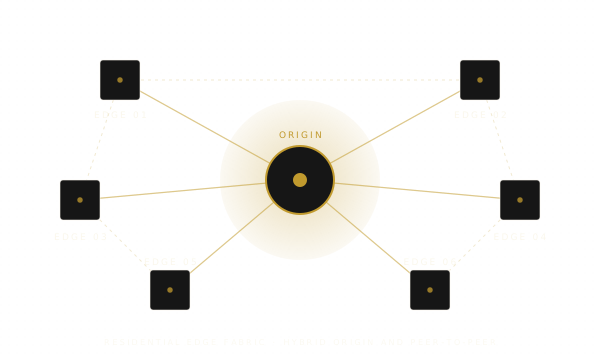

Delivery peer
Bandwidth relay for the edge CDN. Would reduce origin egress and improve last-mile latency for the viewer next door, within what residential uplink can honestly carry.

Storage cache
Operator-controlled cold storage. Would hold gifted unlocks, master-quality preloads, and cohort content close to where it will play.

Compute node
Local-first hybrid inference. Spare cycles could one day serve the workloads that fit consumer silicon, with heavier jobs staying in the cloud. The operator would pick what runs.

B2B compute
Research, studio, and scientific workloads, if the earlier phases earn the trust. Active interest from the computational biology research community.
Operators would earn credits weighted by hardware trust tier and content tier, and the credit ledger would settle in fiat. Nothing in this design requires a coin, and nothing about joining the grid asks the operator to speculate on one.
Operators choose
who their compute serves.
The platform will not capture the operator's spare-compute decision. When the grid reaches its compute phases, operators will choose which artists, studios, and research customers receive their cycles. The platform's job will be to keep the marketplace honest and to settle credits.
Two B2B verticals are nearest at hand. The first is computational biology, where there is active interest in non-trivial image-workload runs on the grid once it is alpha-ready. The second is consumer-tier AI inference at scale, where the latency and power profile of a residential node could beat a hyperscaler hop on the workloads that fit.
The point is not that the grid replaces the data center. The point is that the operator, not the platform, gets to decide whose work runs on hardware they own.
The operator owns the box. The operator owns the choice of what runs on it. The platform owns the rails, not the routing.
Large private AI is consolidating
into a small number of data centers.
That trend is real, expensive, and not stopping. It is also not the only viable shape for the next decade of compute. There is an alternative that could scale residentially, on hardware that pays for itself by doing something the household already wanted.
The same TsugiNode that resolves a 12-bit master to your panel could one day serve a neighbor's playback, hold a creator's catalog close to the viewers who paid for it, and run a tranche of inference on behalf of a researcher the operator chooses to support. Each of those is a small unit. The grid is what would make them add up.
That is the long bet. Compute, storage, and AI back in the hands of the people, on hardware they own, paying them for the picture they wanted in the first place.
Seven filed US provisional patents.
One working pipeline.
Foundational synchronization for the dual-decoder context. Filed 2026-02-19.
4K 12-bit 4:4:4 from a 30 to 38 GB file: master-quality delivery at a fraction of the bitrate a full master would otherwise require. Filed 2026-05-01.
Plesiochronous gradient consensus. The substrate for the residential compute grid. Filed 2026-05-01.
Specifications are filed at the USPTO. External patentability and value assessments have been completed across the portfolio. The grid is not a sketch on a napkin.
Four additional provisionals filed in May 2026.
Continual fine-tuning, non-convex optimization, and adaptive meta-optimization. Enterprise IP for the optimization division alongside the consumer cinema stack.
Continual fine-tuning via a small pool of LoRA adapters. The software analog of Infinity. Filed 2026-05-07.
Multi-resolution renormalization optimizer for non-convex objectives. Filed 2026-05-07.
Coupled-map-lattice gradient smoothing for non-convex periodic optimization. Filed 2026-05-07.
Probe-routing meta-optimizer that adapts the optimizer to the workload. Filed 2026-05-27.
Buy the box for the picture.
Join a grid by doing it.
The catalog and the box come first. Phase 1 adds the delivery grid, Phase 2 the storage layer, and Phases 3 and 4 the long-dated bet on consumer-owned compute. The waitlist is the on-ramp for all of it.